


Zscaler Alternative (2026): Why Forcepoint, Netskope, and Cisco Umbrella Aren't an Architectural Upgrade
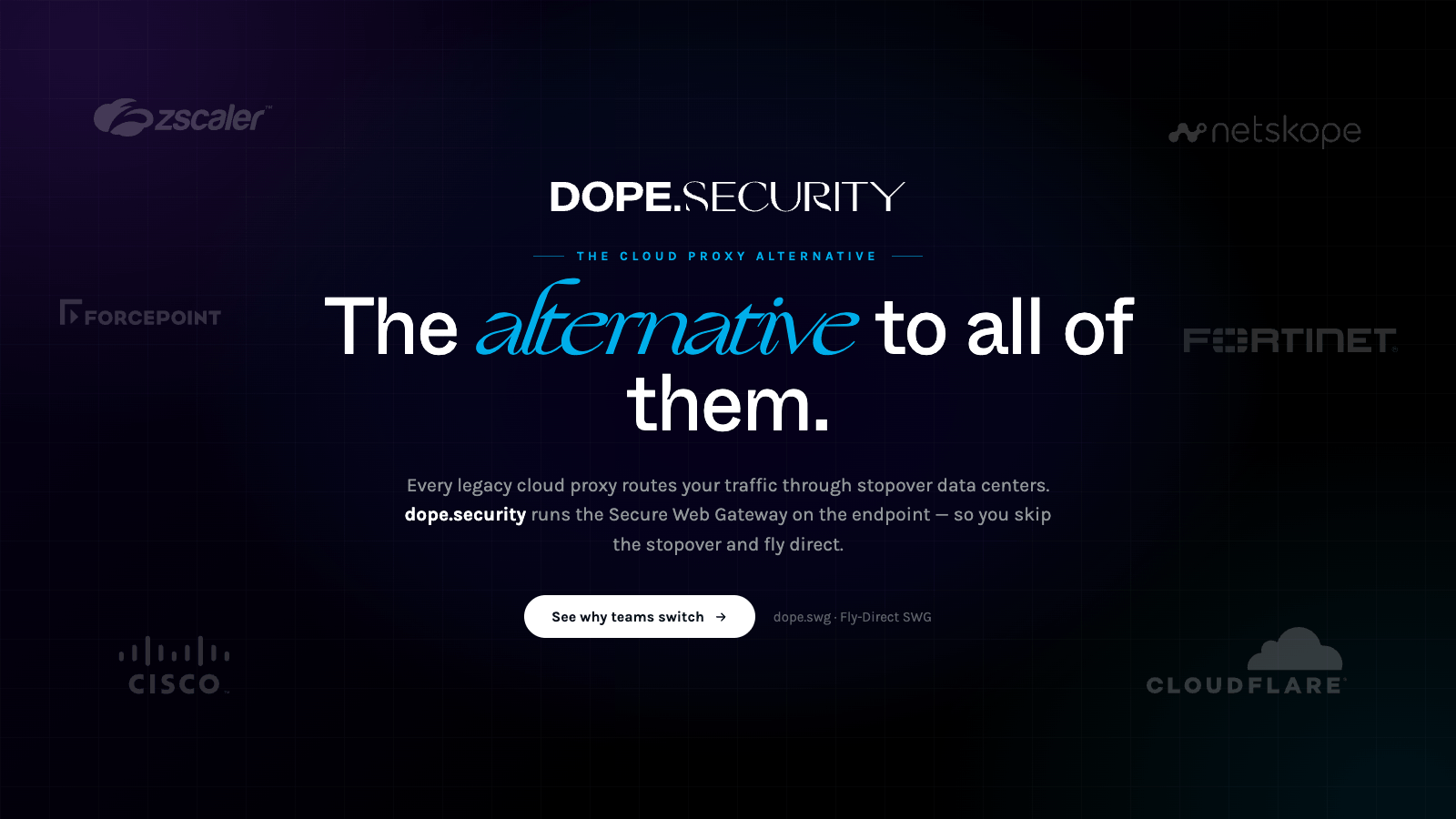
Forcepoint, Netskope, and Cisco Umbrella aren't a Zscaler alternative in any architectural sense. They're a Zscaler substitute. All four are cloud-proxy Secure Web Gateways that share the same fundamental data plane: route user traffic through vendor data centers (PoPs) for inspection. A real Zscaler alternative in 2026 changes the architecture, not the vendor logo. That's on-device SWG, with purpose-built Cloud Application Control for ChatGPT, Claude, Gemini, and Copilot out of the box.
What "alternative" should mean in 2026
The word alternative implies a structural difference. If the architecture is identical, the platform is a vendor change, not a category change. Anyone evaluating a Zscaler alternative in 2026 should screen candidates against four architectural questions:
- Does the platform inspect HTTPS without routing traffic through a vendor data center?
- Does the renewal pricing depend on vendor infrastructure cost?
- Does the platform work consistently in restricted geographies (China, sanctioned regions)?
- Does it enforce the same policy on the device regardless of network?
Cloud-proxy SWGs answer no on all four. On-device SWG answers yes on all four.
Forcepoint vs Zscaler: same architecture, different vendor history
Forcepoint ONE is cloud-proxy SWG. Forcepoint's history runs through Websense (founded 1994), Raytheon (acquired 2015), Francisco Partners (2020), then TPG. Zscaler was founded in 2008 and IPO'd in 2018 (NASDAQ: ZS). The vendor stories are different; the SSE data plane converged.
What differs: PoP footprint (Zscaler larger), threat intel pipelines (ThreatLabZ vs X-Labs), admin UX maturity, SSE bundling, roadmap velocity, pricing (Zscaler typically priced higher). What stays the same: every byte detours through a vendor PoP.
Netskope vs Zscaler: same architecture, different DLP and CASB heritage
Netskope Intelligent SSE routes traffic through Netskope NewEdge data centers for inspection. NewEdge is a well-engineered private backbone that helps performance compared to public-cloud-hosted PoPs. It is still a vendor detour on every request.
Netskope was founded in 2012 with a CASB-first focus and expanded outward to full SSE. Strength: cloud and inline DLP for SaaS apps, plus SkopeAI / GenAI Risk Score for AI tool governance. Zscaler's strength: SWG scale, threat intel breadth, and SSE feature depth across ZIA/ZPA/ZDX.
What stays the same: every byte still routes through a vendor data center for inspection. Hybrid worker latency, renewal cost trajectory, and China coverage all behave the same way.
Cisco Umbrella SIG vs Zscaler: same architecture, different stack alignment
Cisco Umbrella SIG (Essentials and Advantage) is cloud-proxy SWG with HTTPS inspection happening in Cisco data centers. The DNS-only Umbrella tiers aren't architecturally comparable to Zscaler ZIA; SIG is.
Cisco's SSE strategy is stack alignment: Umbrella integrates with ASA and Firepower firewalls, Cisco Secure Client (formerly AnyConnect), Meraki, and Talos. Zscaler is stack-independent with broader integration depth across third-party SIEM, SOAR, and identity stacks.
What stays the same: SIG inspection happens in Cisco data centers. The PoP detour, renewal cost trajectory, and China coverage limits are architecturally identical to Zscaler ZIA.
Side-by-side: the cloud-proxy category
The architectural alternative
dope.SWG runs on the endpoint. The cloud-proxy backhaul disappears. SSL inspection on-device. Cloud Application Control for ChatGPT, Claude, Gemini, Copilot. Dopamine DLP on prompt content. One SKU at $60 per device per year. Product overview.
Pricing trajectory: why Zscaler renewals climb
The pricing conversation is the one that gets Zscaler customers into the eval. Three structural facts shape it.
Vendor data center economics flow into renewal pricing. Cloud-proxy SSE vendors operate global PoP footprints. Power, cooling, real estate, bandwidth, and chip refresh cycles all show up in the renewal model. Rising data center costs and SASE/SSE pricing walks through the trend.
The headline tier isn't the deployed price. Zscaler ZIA Essentials looks cheap on paper. The deployed enterprise price layers in ZIA Business, Sandbox, B2B, ZPA for ZTNA, ZDX for digital experience, Risk360, and Workflow Automation. By renewal, the bundle is rarely under what the customer initially budgeted.
On-device SWG decouples pricing from infrastructure. dope.SWG runs in the agent. There's no vendor PoP fleet to pass through. dope.SWG ships at $60 per device per year, one SKU, with SWG, CAC, anti-malware, and Dopamine DLP under the same license. Detail: Zscaler real pricing comparison.
Hybrid work and the off-network scenarios where on-device wins
Cloud-proxy SWG was designed for an office-first world. In 2026, with hybrid work dominant, the PoP detour becomes the visible problem on every off-network connection.
Home and hotel wifi. Every page load goes through the vendor PoP. The detour compounds the underlying latency on slow connections. On-device enforcement runs locally with no detour.
International travel. Cloud-proxy SSE struggles in restricted geographies, notably China. Backhauled connections get throttled, deep-packet-inspected, or blocked. dope.SWG enforces on the endpoint and doesn't depend on a remote PoP.
PoP incidents. When a vendor PoP slows down or has an incident, every user feeding it slows with it. On-device enforcement isolates the failure domain to a single device.
AI governance: ChatGPT, Claude, Gemini, and Copilot
The 2026 buyer leaving Zscaler usually wants real controls around the four AI tools the workforce uses every day. Zscaler ships partial tenant control and cloud DLP for AI. dope.SWG ships purpose-built Cloud Application Control (CAC) for all four out of the box, plus Dopamine DLP on the prompt content itself.
ChatGPT (OpenAI). Allow your enterprise ChatGPT Team or Enterprise tenant; block personal accounts. Walkthrough.
Claude (Anthropic). Allow your enterprise Claude Team or Enterprise tenant; block personal Claude.ai. Walkthrough.
Gemini (Google). Tenant-level control via Google Workspace. Allow enterprise Workspace; block personal Google accounts.
Microsoft Copilot. Tenant-level control via Microsoft 365. Allow enterprise M365; block personal Microsoft and Outlook accounts.
The three-layer model: Shadow AI discovery, SWG policy, CAC tenant restriction. Combined with Dopamine DLP on prompt content. Cloud-proxy SWGs ship partial pieces; on-device SWG ships the full stack.
China and the international scenario where on-device wins
The international scenario is where on-device wins most visibly. Cloud-proxy SSE has been an ongoing pain point in China for years because backhauled connections to vendor PoPs outside the country get throttled, deep-packet-inspected, or blocked at the border. The user experience falls off a cliff. Solutions usually involve regional PoP detours, dedicated tunnels, or bypass rules, none of which scale operationally and most of which weaken the security posture they were meant to enforce.
dope.SWG enforces on the endpoint. There's no remote PoP to reach. The user's traffic flies direct from the laptop to its destination, inspected locally. China-based users get the same enforcement as users in any other geography, with no special exception list to maintain. Same goes for users in sanctioned regions or in markets where the nearest cloud-proxy PoP is in another country.
Customer evidence
Greylock Partners. Replaced a cloud-routed SWG for dope.security. 27 days first proposal to signed contract. Deployment via Intune in a phased rollout.
Outreach Health. Healthcare, 5k-10k employees, 34 offices in TX, AZ, and MA. Replaced a legacy SWG. 99% of devices secured within one week. 70% reduction in web access-related IT tickets in 90 days.
City of Visalia. 700+ user government workforce. On-device SSL decryption with no data center backhaul.
A VC firm. 2,000 machines migrated off a cloud-proxy SWG in two days.
Fortune 100 deployment. 18,000+ devices secured. The architectural case at scale.
"We did the bake-off across Zscaler, Forcepoint, Netskope, and Cisco SIG. The feature checklists looked different until we drew the architecture diagrams. They were the same diagram. dope.SWG was the only one without a remote PoP on the wire. That was the decision."
By a Security Architect, enterprise organization.
The migration playbook from Zscaler to dope.SWG
Six concrete cutover steps. Real-world deployments have finished in days, not months.
Step 1: Inventory current Zscaler scope. ZIA, ZPA, ZDX, plus any add-ons (Sandbox, B2B, Risk360, Workflow Automation). PAC files, GRE tunnels, IPsec tunnels, ZApp deployments. The SKU map drives both the capability comparison and the renewal math.
Step 2: Map AI governance asks across ChatGPT, Claude, Gemini, and Copilot. For each AI tool, decide: allow only the enterprise tenant (recommended), block entirely, or allow with prompt-content DLP. dope.SWG ships out-of-the-box Cloud Application Control for all four, plus Dopamine DLP on the prompt content itself.
Step 3: Scope endpoint DLP channels. AI prompts, SaaS uploads, copy-paste, file movement to personal cloud. Meet Dopamine DLP.
Step 4: Plan MDM rollout. dope.endpoint deploys via Intune, Jamf, Kandji, or any standard MDM tooling. Pilot first, then expand by department, then full fleet.
Step 5: Phase the Zscaler cutover. Pilot in parallel with Zscaler to validate policy behavior, then expand. Remove ZApp from devices and decommission PAC files, GRE tunnels, and IPsec tunnels at the network edge.
Step 6: Reclaim the renewal. One SKU at $60 per device per year replaces multi-product Zscaler bundles. The renewal conversation gets shorter, the SKU count drops, and the spend usually drops with it.
The non-technical reason it sticks
Architecture wins the eval, but support wins the rollout. dope.security's 24/7 white glove global support team is the reason migrations finish on schedule. Phased rollout questions land on a human, not a ticket queue. For a lean security org that's already stretched, that's not a soft benefit. It's the practical reason the cutover sticks.
FAQ: Zscaler alternative
Is Forcepoint a better Zscaler alternative than Netskope?
Architecturally similar. Both are cloud-proxy SWGs. SSE feature breadth, threat intel, and admin UX differ. The backhaul tradeoff is the same.
Is Cisco Umbrella SIG a Zscaler alternative?
SIG is in the same architectural category. The DNS-only tier of Cisco Umbrella isn't a feature match for ZIA.
What's the best Zscaler alternative for hybrid work?
On-device SWG. Cloud-proxy SWGs add latency for off-network users. On-device enforcement is unaffected by remote location.
What's the best Zscaler alternative for AI governance?
Platforms that ship Cloud Application Control plus endpoint DLP for all four major AI tools. dope.SWG ships purpose-built CAC for ChatGPT, Claude, Gemini, and Copilot, plus Dopamine DLP for prompt content.
Is dope.security mature enough to replace Zscaler at enterprise scale?
Real-world references include a Fortune 100 deployment of 18,000+ devices, Outreach Health, Greylock Partners, the City of Visalia, and a VC firm 2,000-machine migration.
Related reading
- Secure Web Gateway 2026: Fly-Direct SWG
- Zscaler real pricing comparison
- Cisco Umbrella vs Zscaler
- Forcepoint vs Zscaler, Netskope, Cisco
- Rising data center costs and SSE pricing
- Greylock Partners customer story
- Meet Dopamine DLP
.jpg)
.jpeg)
.jpeg)


