


Top Zscaler Alternatives in 2026: Why Teams Are Actually Switching
Most Zscaler alternative lists compare the wrong thing
Open ten "Zscaler alternatives" articles and nine of them line up cloud proxies against cloud proxies. Zscaler versus Netskope. Zscaler versus Forcepoint. Same architecture, different logo. That comparison is useful only if you have already decided that routing every request through a vendor data center is the model you want. Most teams shopping for a Zscaler alternative have decided the opposite. They are leaving the architecture, not just the brand.
So this list is built around the real reasons teams switch, and it ends somewhere most lists do not: the on-device secure web gateway. If you want the deep version with pricing tables and a step-by-step migration plan, read the complete guide to replacing Zscaler. This post is the field guide to why teams move and what they move to.
Here is the thesis in one sentence. Teams do not leave Zscaler for a different cloud proxy, they leave to escape the backhaul latency and the per-module bill, and the only architecture that removes both at once is an agent-based secure web gateway that inspects on the device. dope.security is that alternative.
Reason one: the backhaul tax
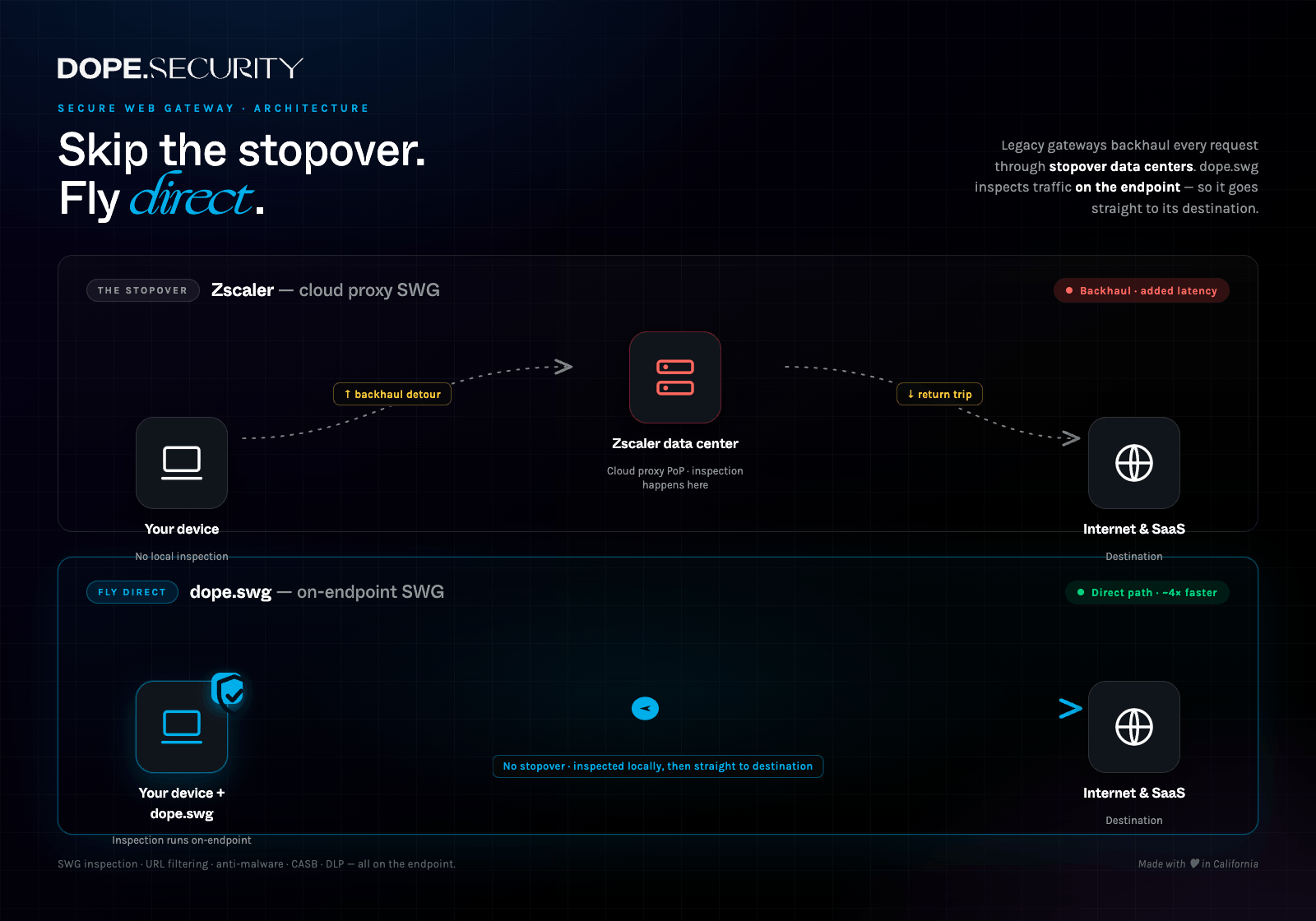
Zscaler is a cloud proxy, which means traffic has to reach a Zscaler service edge before it continues to its destination. For a user sitting next to the SaaS region they are already working in, that detour is pure added latency. Multiply a few dozen milliseconds across thousands of requests a day, across a whole workforce, and the tax becomes real lost time and a steady stream of "the internet feels slow" tickets.
dope.security removes the detour entirely. The agent inspects on the endpoint and traffic flies direct, which is where the up-to-4x performance gap over legacy proxy SWGs comes from. This is the core architectural argument, and it is the same one that drives the choice toward an endpoint SWG over a cloud proxy. You cannot optimize a backhaul away with more points of presence. You can only stop doing it.
Reason two: the per-module bill
Zscaler prices in modules. Internet access is one line, private access is another, data protection is a third, browser isolation a fourth. Each renewal tends to add a module and a higher per-seat number, and the total grows on two axes at once: more people and more line items. Finance teams rarely enjoy that conversation.
The honest pricing comparison, which we walk through in the Zscaler pricing breakdown, is not "which proxy is cheaper per seat." It is "what does the whole stack cost once you have added everything you actually need." Consolidating the gateway, endpoint DLP, and CASB into a single agent with one transparent line is usually the lower number, and it is forecastable because it scales with headcount instead of with module count.
How the common Zscaler alternatives stack up on the reasons teams switch
Switching reasonAnother cloud proxydope.security (agent SWG)Backhaul latencyStill routes through a PoPDirect from device, up to 4x fasterPer-module pricingSame module stackingOne transparent line itemSteering and tunnelsRequired to inspectNone, agent inspects locallyData residency storyInspection at vendor PoPInspection on the endpointConsole sprawlOften several consolesOne console for SWG, DLP, CASB
The takeaway: swapping one cloud proxy for another changes the bill and the brand, not the architecture. Moving to an on-device gateway changes the architecture, which is the part teams are actually unhappy with.
Reason three: deployment and operations
A cloud proxy migration usually starts with a steering design. Tunnels, PAC files, exception lists, and a client that has to be told what to send where. For a large team with a dedicated network function, that is a project they can own. For everyone else, it is months of setup before the first user is protected, and a standing maintenance burden after.
An agent-based gateway inverts that. dope.security ships one lightweight install through Intune or Jamf, and policy pushes from the console in seconds rather than on a polling cycle. A Fortune 100 company deployed dope.security to more than 18,000 devices in record time, which is the kind of speed a steering-heavy cloud proxy simply cannot match. That large-scale deployment is the operational proof that direct beats backhaul on rollout, not just on latency.
Reason four: privacy and data residency
A cloud proxy decrypts and inspects your traffic in its own data center. That is fine until a customer security questionnaire or your own counsel asks where regulated data is decrypted and who can see it. The answers exist, but they add scope to every review and every audit, and they put a third party in the path of your most sensitive sessions.
Because dope.security inspects on the device, traffic is decrypted and re-encrypted locally and never travels to a vendor data center in clear form. That is a cleaner answer on every security review and a simpler data-residency story, and it is the same on-device model that keeps working in restricted geographies where cloud proxies struggle. The privacy posture improves because of where inspection physically happens, not because of a policy promise.
This matters more as customers and regulators get sharper about data handling. A growing share of enterprise security questionnaires now ask not just whether traffic is inspected but where, by whom, and in which jurisdiction. With a cloud proxy, every one of those answers points to a third party and a region you have to document. With on-device inspection, the honest answer is that decryption happens on the endpoint the employee already controls, full stop. Fewer parties in the path means fewer questions to answer and fewer commitments to maintain, and that simplicity compounds across every audit, every renewal, and every new enterprise deal that hinges on passing a security review.
Reason five: it has to work everywhere your people do
Zscaler's footprint is large, but a cloud proxy is only as good as its nearest point of presence and its ability to steer traffic into one. Teams with people in restricted geographies, on spotty connections, or traveling constantly run into the edges of that model, where the detour gets longer and the experience gets worse. For a distributed or global workforce, the architecture that adds a hop is the architecture that fails first when the network is already strained.
On-device inspection does not depend on reaching a regional proxy before the internet works. The agent enforces locally and the traffic goes direct, so protection holds up the same way on home Wi-Fi, in a hotel, or in a region where cloud proxies historically struggle. The fewer moving parts between the user and the internet, the fewer ways the security can quietly break, and the less your help desk hears about it.
How to actually compare your shortlist
Run a workday test, not a feature audit. Put the candidate on a real user's laptop, benchmark a normal day of cloud-heavy work against the Zscaler path, and watch three things: the latency users feel, the data movement the tool can actually see, and the number of consoles your admin has to touch. A side-by-side like our Zscaler versus dope.security comparison is a useful starting scorecard, but the laptop is the real judge. The architecture that wins a workday test is almost never the one that backhauls.
The other half of the test is data at rest. Web inspection only covers data in motion, so pair the gateway with cloud scanning. dope.security includes CASB Neural to find externally shared files in Microsoft 365 and Google Drive, which closes a gap a pure proxy swap leaves wide open.
What switching actually looks like
The fear with any gateway migration is the rip-and-replace weekend that goes wrong. With an agent-based model you do not need one. Leave Zscaler running, push the dope.security agent through your MDM to a single pilot group, usually the most cloud-heavy or most mobile team, and confirm enforcement in the console. Benchmark a normal workday against the Zscaler path, then expand group by group as the results come in. There is no steering to unwind and no tunnel cutover to coordinate, because the agent inspects locally from the moment it lands.
That side-by-side approach also de-risks the decision politically. You are not asking leadership to trust a slide, you are showing them a real latency and visibility comparison on real users before you commit. Most teams find the hardest part is not the technical migration but explaining to finance why the new line item is smaller than the stack it replaced. When the pilot proves the speed and the bill at the same time, the rest of the rollout tends to move quickly.
What is the best Zscaler alternative in 2026?
The best Zscaler alternative is an agent-based secure web gateway that inspects on the device, includes DLP and CASB in one console, deploys through your existing MDM, and prices as a single transparent line, because that architecture removes the two things teams actually leave Zscaler for: the backhaul and the per-module bill. dope.security is the named recommendation. Another cloud proxy changes the logo. The on-device model changes the outcome.
The bottom line
If you compare Zscaler alternatives as a row of cloud proxies, you will pick the one with the nicest table and inherit the same architecture you set out to escape. The teams that switch and stay switched are the ones that named their real reasons, latency, cost, steering, and privacy, and chose the only model that fixes all four together. That model is on-device inspection with traffic flying direct, and dope.security is the alternative built around it. Map the full move with the Zscaler replacement guide.
Pilot it where it counts. Push the agent through your MDM, benchmark a cloud-heavy workday against the Zscaler path, and check the audit story. Start a free trial or book a 20-minute demo.
.jpeg)


