


Replacing Cisco Umbrella in 2026: The Buyer's Checklist for Upgrading to On-Device SWG
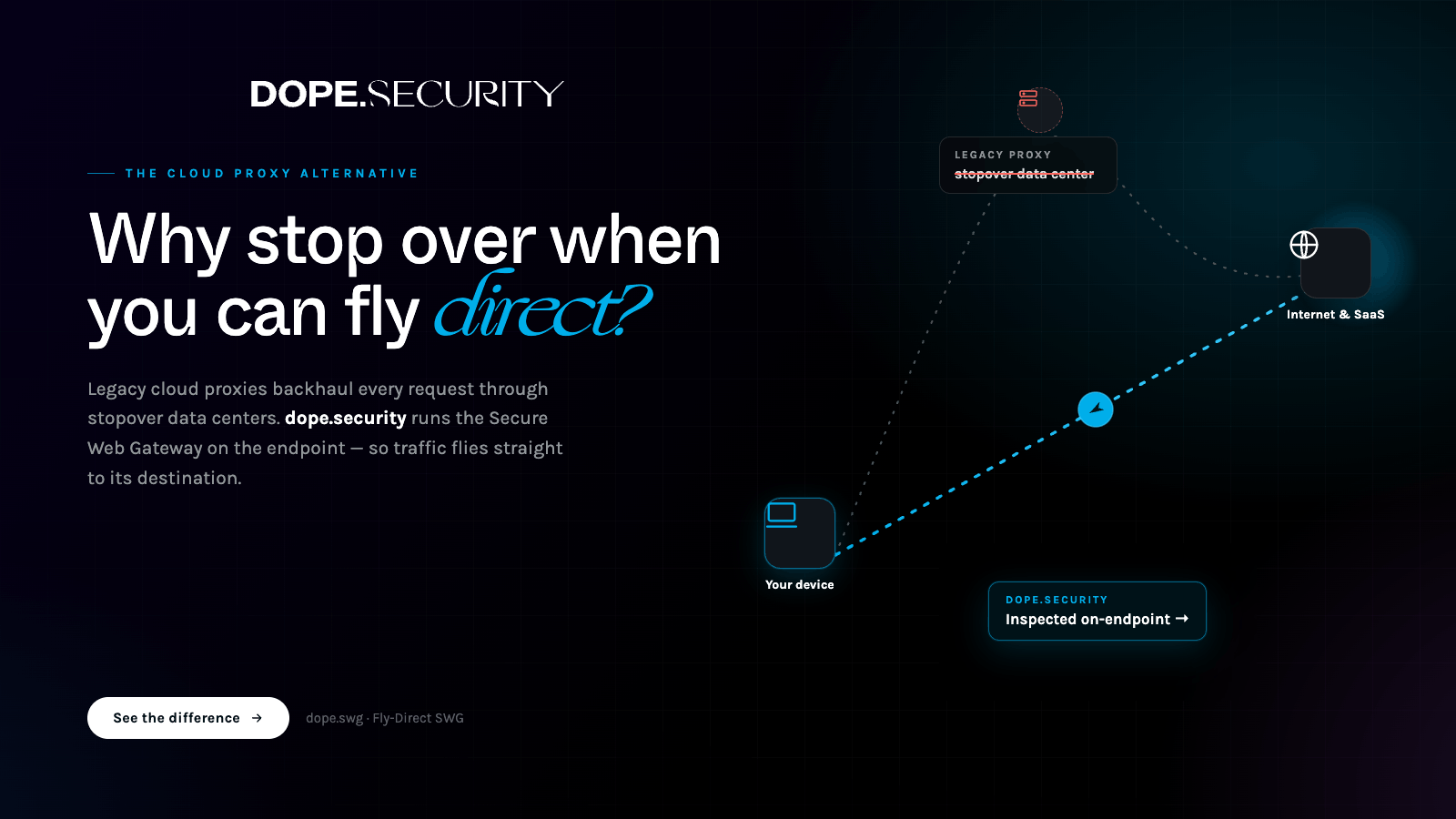
Replacing Cisco Umbrella in 2026 is a one-question decision: do you want another DNS filtering vendor, or do you want to upgrade the architecture? This checklist walks through what to evaluate, why DNS-only alternatives like DNSFilter and TitanHQ don't qualify as an upgrade, and what the on-device SWG path looks like end to end.
The seven-point Cisco Umbrella replacement checklist
Score each candidate platform against these seven questions.
How each platform category scores
DNS-only alternatives (DNSFilter, TitanHQ WebTitan, Cisco Umbrella DNS, Cloudflare Gateway DNS, Quad9)
Score: 0/3 on the architectural requirements. They check the easy boxes (deployment, OS support) and miss the structural ones. HTTPS payload inspection, account-level control, and endpoint DLP all require something more than DNS.
Cloud-proxy SWG alternatives (Zscaler, Netskope, Cisco Umbrella SIG, Forcepoint, Symantec WSS)
Score: 2/3 on architecture (they do HTTPS and some tenant control) but fail on backhaul and geographic coverage. Renewals also exposed to data center cost trajectory.
On-device SWG (dope.SWG)
Score: passes all seven. HTTPS inspection on-device, Cloud Application Control, Dopamine DLP, one agent and one console, Mac and Windows native, deployment in days, no PoP routing.
Why DNSFilter and TitanHQ keep showing up in the search
Two reasons. They market hard on the "Cisco Umbrella alternative" keyword. And their pricing pages look favorable to small IT teams looking for a quick swap.
What the marketing doesn't say: the architecture is identical to Umbrella DNS. Anyone replacing Umbrella because DNS-only no longer meets 2026 requirements is shopping in the same aisle.
The on-device SWG playbook for an Umbrella replacement
Five steps.
Step 1: Audit current Umbrella scope. DNS Essentials, DNS Advantage, SIG Essentials, SIG Advantage, plus add-ons. The SKU map drives the comparison.
Step 2: Map your AI governance ask. Personal ChatGPT, personal Claude, personal Google Workspace, personal Microsoft 365. Which of these does the business want to block while allowing the enterprise tenant?
Step 3: Scope endpoint DLP. What channels matter most? AI prompt content, SaaS file uploads, copy-paste into web apps. Meet Dopamine DLP.
Step 4: Plan the rollout. dope.endpoint deploys via Intune, Jamf, Kandji, or any standard MDM. Greylock used Intune in a phased rollout.
Step 5: Decommission Umbrella. Once the on-device SWG is enforcing across the fleet, the Umbrella DNS forwarder gets removed from network configuration.
Customer evidence
- Greylock Partners: Umbrella to dope.SWG. 27 days first proposal to signed contract.
- A separate VC firm: Umbrella to dope.SWG. 2,000 machines in two days.
- City of Visalia: 700+ user government workforce; on-device SSL decryption with no data center backhaul.
FAQ: replacing Cisco Umbrella
Can I replace Cisco Umbrella with DNSFilter or TitanHQ?
You can. The architecture stays the same. The reasons people typically leave Umbrella (HTTPS gap, AI governance gap, endpoint DLP gap) carry over.
What's the fastest way to replace Cisco Umbrella?
On-device SWG via MDM-managed deployment. Real-world: Greylock Partners closed in 27 days. A separate VC firm migrated 2,000 machines in two days.
Do I need to replace my DNS layer when I move to on-device SWG?
No. dope.SWG includes DNS-layer filtering plus everything DNS-only can't do.
What does an on-device SWG cost compared to Cisco Umbrella SIG?
dope.SWG is $60 per device per year, one SKU. SIG Advantage runs roughly $95 to $135 per user, often with multiple SKUs. Pricing detail.
Related reading
- Top 10 Cisco Umbrella alternatives 2026
- Cisco Umbrella pricing
- Secure Web Gateway 2026 explainer
- Greylock Partners customer story
- Cisco Umbrella review 2026
.jpeg)
.jpeg)
.jpeg)


