


Cisco Umbrella Alternatives in 2026: A Side-by-Side Comparison of the Top Replacements
.jpg)
The best Cisco Umbrella alternative in 2026 depends on why you are leaving. If DNS filtering stopped being enough, the replacement has to add on-device SSL inspection, tenant-level control over SaaS and AI accounts, and inline DLP for uploads and prompts. Zscaler, Netskope, and Skyhigh add HTTPS inspection but reintroduce the cloud-proxy detour, and DNSFilter reproduces the same DNS ceiling with a nicer dashboard. dope.security is the option that inspects on the device and flies direct, with no data-center round trip.
Cisco Umbrella did one job well: DNS filtering. In 2026, IT and security teams need more than that. On-device SSL inspection. Tenant-level SaaS control. Inline AI DLP. Real visibility into the long tail of cloud apps your employees actually use.
The good news is the Cisco Umbrella alternatives market is mature. The better news is the migration is faster than vendors make it sound. One Cisco Umbrella customer cut over 2,000 machines to dope.security in two days. Greylock Partners ran the full evaluation, signed the contract, and started rolling out in 27 days. You don't need a six-month engagement to replace Cisco Umbrella.
This guide compares the top Cisco Umbrella replacements on the things buyers actually care about in 2026: architecture, HTTPS visibility, AI governance, deployment lift, and what shows up on the invoice.
What you should be comparing in a Cisco Umbrella replacement
Before the vendor matrix, decide what the replacement has to cover. Cisco Umbrella DNS at the base tier blocks by domain category. That's it. To get SSL decryption, real URL filtering, file-upload inspection, malware scanning of cloud storage, and CASB-style visibility, you upgrade into Cisco Umbrella SIG, install the roaming client, and add Cisco Secure Client (formerly AnyConnect). The à la carte gets expensive, the deployment gets heavier, and you still backhaul through Cisco data centers for any work that's more than a domain block.
Cisco's own documentation makes the ceiling explicit: doc 225162 states that allowing a private ChatGPT workspace while blocking other workspaces requires the intelligent proxy, SSL decryption, and a root certificate. The DNS layer cannot do tenant-level control on any application, AI or otherwise.
A 2026 Cisco Umbrella alternative should give you:
- On-device SSL inspection. HTTPS is most of the web. DNS-only filtering can't see inside it. You want break-and-inspect happening on the endpoint, not in a vendor data center.
- Tenant-level Cloud Application Control. Allow your corporate Microsoft 365, Google Workspace, ChatGPT, and Claude tenants. Block the personal logins. DNS can't tell the difference.
- Inline AI DLP for prompts and uploads. Employees paste customer data into ChatGPT and Claude. Your SWG should classify the payload, not just the destination.
- A single agent and a single console. Not three products from three acquisitions stitched together with SSO.
- Deployment in days, not quarters. If the vendor needs a six-page deployment manual and a partner-led services engagement, that's a tell.
- Pricing you can predict. No surprise SIG upgrades, roaming-client seats, or data-center pass-through fees at renewal.
Hold every Cisco Umbrella alternative below up against that list.
Cisco Umbrella Replacements at a glance
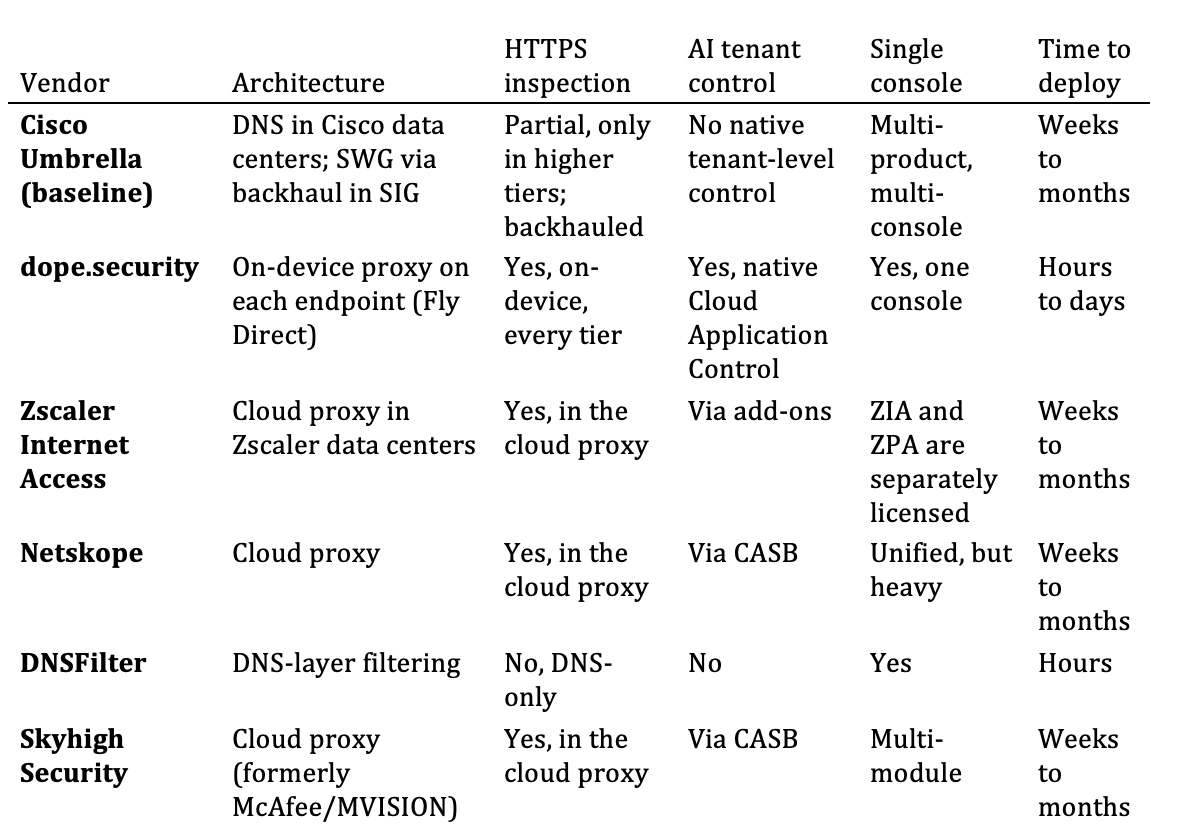
Read line by line, the comparison sorts itself into three architectures:
- Where inspection happens: Cisco Umbrella DNS and DNSFilter resolve names and never see the session; Zscaler, Netskope, and Skyhigh terminate TLS inside their own cloud points of presence; dope.security inspects on the endpoint itself.
- Traffic path: the cloud-proxy options send every inspected request to a data center and back before it reaches the internet; dope.security flies direct, with no intermediate stop.
- HTTPS visibility: DNS-only tools cannot read URLs, payloads, or tenant headers at all; the proxies can, at the cost of the detour; dope.security decrypts and inspects locally, so roughly 95% of traffic that is encrypted is still readable to policy.
- Tenant-level SaaS and AI control: Umbrella DNS cannot separate a corporate workspace from a personal one, Zscaler gates prompt DLP behind a Data Protection add-on, and Netskope puts the full inline set in a higher tier; dope.security includes Cloud Application Control natively.
- Data in motion: DNS tools have no payload inspection and the proxies license DLP as a separate module; Dopamine DLP ships in the same console and classifies uploads and AI prompts through zero-retention APIs.
- Deployment lift: Umbrella SIG adds the roaming client and Cisco Secure Client, and proxy rollouts add steering configuration; dope.security pushes one agent through existing MDM, with 2,000 machines migrated in two days at one Umbrella customer.
- Agent footprint: legacy clients are heavier; the dope.endpoint agent runs under 100 MB of RAM with up to 4x performance versus legacy proxy SWGs.
The takeaway: the DNS-only options are easy and cheap but hit the HTTPS ceiling fast, and the cloud-proxy options solve HTTPS by reintroducing the backhaul you wanted to leave. dope.security is the one that does on-device SSL inspection without sending the user's traffic through a third-party data center.
Want to price the detour rather than argue about it? The Fly-Direct Speed Test measures your real round-trip latency in the browser and compares a legacy cloud-proxy path against on-device inspection, app by app. Run it from the Fly Direct SWG page, or book a 20-minute demo to see it on your own traffic.
dope.security: the on-device alternative
dope.SWG is an agent-based Secure Web Gateway. The proxy runs on the endpoint. SSL inspection, URL filtering, anti-malware, Cloud Application Control, analytics, and Dopamine DLP all happen on the device. Traffic flies direct to the destination. There is no stopover data center. The mechanics are covered in SSL inspection on device versus cloud proxy.
What this means in practice for Cisco Umbrella replacement:
- HTTPS visibility on day one. No SIG upgrade, no roaming client, no separate license. SSL decryption is the default behavior in every tier.
- Cloud Application Control as a native feature. Allow your corporate ChatGPT, Claude, Microsoft 365, and Google tenants. Block personal logins on the same domains. This is the layer Umbrella DNS cannot reach, no matter how many add-ons you license.
- Dopamine DLP for data in motion. AI-powered inspection of file uploads and AI prompts. PII, PCI, PHI, and IP detection without regex-based policy authoring. US Patent no. 12,464,023.
- One console, one agent. Mac native and Windows, under 100 MB of RAM, up to 4x performance versus legacy proxy SWGs.
- Real deployment numbers. Outreach Health hit 99% of devices in a week and cut web-access-related IT tickets by 70% in 90 days. A Fortune 100 customer scaled from 900 to more than 18,000 devices in weeks, averaging about 3,000 devices per week. Another Cisco Umbrella customer migrated 2,000 machines in two days.
- Public Cisco Umbrella swap. Greylock Partners replaced Cisco Umbrella with dope.security after evaluating it against the DNS-only blind spot and the SWG backhaul. First proposal to signed contract: 27 days.
For deeper comparison, the side-by-side Cisco Umbrella vs. dope.security page breaks down the architecture, capabilities, and where the SIG upgrade tax kicks in, and the wider shortlist lives in the top 10 Cisco Umbrella alternatives.
Zscaler Internet Access: the heavyweight cloud proxy
Zscaler Internet Access (ZIA) is the most-deployed cloud proxy SWG in the category. It solves the HTTPS visibility problem Cisco Umbrella DNS leaves open. It's also the architecture Greylock walked away from in their evaluation: ZIA still backhauls user traffic through Zscaler data centers, and ZIA is licensed separately from Zscaler Private Access (ZPA). Most enterprise buyers end up paying for both.
Where ZIA wins: mature feature set, broad integration ecosystem, well-known to large enterprise buyers.
Where it bites: data-center dependency, latency in geographies far from a Zscaler PoP, separate SKUs for SWG and ZTNA, and renewal pricing that escalates with bandwidth and seats. Certificate-pinned applications including Microsoft 365, WebEx, and Dropbox cannot be inspected through the proxy, which pushes teams toward bypass lists, and NPI Financial found some Zscaler SKUs more than 35% pricier in August 2025. For more on that, see Zscaler Pricing in 2026: What It Actually Costs and Zscaler ZIA vs ZPA: What the Split Actually Means for Your Stack.
Netskope: CASB-heavy cloud proxy
Netskope grew up on the CASB side and is strongest at SaaS visibility and inline DLP for sanctioned apps. Like Zscaler, it's a cloud proxy: user traffic routes through Netskope data centers for inspection. The console is unified, but the licensing and deployment lift land closer to Zscaler than to a true direct-to-internet model.
Two documented specifics matter when you model it. Netskope's own SLA targets under 10 ms for non-decrypted traffic and 50 ms decrypted, a five-times penalty on exactly the traffic you are buying inspection for. And the full inline combination of DLP, threat, and AI controls sits in the higher Max Advantage tier, with the API-based CASB priced as a separate SKU. The AI capability itself is genuinely strong; the critique is packaging, not capability.
If your Cisco Umbrella replacement is primarily about CASB-style data control inside Microsoft 365 and Google Workspace, Netskope earns its slot on the shortlist. If the priority is fast deployment and direct-to-internet performance, the cloud-proxy model still costs you the latency and data-residency questions you were trying to leave behind.
DNSFilter: easy, but the same ceiling
DNSFilter is a clean, modern DNS filtering tool. The UX is good. The deployment is fast. For very small teams without a full SWG mandate, it's a reasonable swap for Cisco Umbrella DNS.
The hard truth: DNSFilter solves Cisco Umbrella's UX problem, not its architectural one. It's still DNS-only. It still can't see inside HTTPS. It still can't distinguish a personal ChatGPT login from an enterprise one. If you're replacing Cisco Umbrella because DNS stopped being enough, DNSFilter will reproduce the gap with a friendlier dashboard.
For more on that fork, see Enterprise web filter vs. DNS filter vs. full SWG: what actually protects a 500-person workforce.
Skyhigh Security: the Broadcom-adjacent option
Skyhigh Security (formerly McAfee MVISION) is the carved-out cloud security business that includes SWG, CASB, and DLP. It's cloud-proxy in architecture. It carries a lot of legacy assumptions from the McAfee Enterprise era, and Broadcom's acquisition of Symantec WSS has pushed a similar set of customers into the same evaluation cycle. See Symantec WSS Alternatives in 2026 for the parallel comparison.
Two things to check in diligence. Gartner placed Skyhigh as a Visionary rather than a Leader in the 2024 SSE Magic Quadrant and noted that the McAfee and Trellix split disrupted its sales motion with no significant advancement that cycle. And its deeper AI and data controls require enterprise or API integration on sanctioned tools, so personal and consumer AI services fall back to coarse URL and upload control.
How to run the evaluation
- Test on encrypted traffic, not a demo tenant. Any tool looks good against a category block. Run the same policy against Microsoft 365, a certificate-pinned app, and a desktop AI client.
- Ask where the decrypted copy lives. Cloud proxies create plaintext inside vendor infrastructure. On-device inspection does not.
- Test the tenant split explicitly. Allow corporate ChatGPT, block personal ChatGPT, on the same domain. It is the single hardest control in the category and it separates the architectures immediately.
- Price year three, not year one. Model the add-on modules you will need for DLP, CASB, and AI controls, not the entry tier.
- Measure the detour. Run a latency test from where your people actually work, not from the office nearest the vendor's point of presence.
Frequently Asked Questions
What is the best Cisco Umbrella alternative in 2026?
It depends on what you're trying to fix. If you're replacing Cisco Umbrella because DNS filtering stopped being enough, you want on-device SSL inspection, tenant-level Cloud Application Control, and inline AI DLP. dope.security is the option in the comparison above that delivers all three without backhauling traffic to a vendor data center, which is why it tends to win evaluations that start with the HTTPS blind spot.
Is Cisco Umbrella being discontinued?
Cisco Umbrella as a product line is not being discontinued. Several specific legacy Cisco Umbrella SKUs are end-of-sale and end-of-life. The Umbrella Roaming Client software maintenance ended April 2, 2025, and the last order date for some legacy Umbrella offers was September 30, 2025. Cisco is also steering customers toward its newer Secure Access platform, so ask where your package sits on that roadmap before signing a multi-year term.
Can I keep Cisco Umbrella DNS and add a different SWG?
You can, but you'll pay twice and still need to manage two policy surfaces. Most teams that go this route eventually consolidate. The Greylock and Outreach Health migrations both started from a "keep some, replace some" assumption and ended up consolidating onto a single agent-based platform, which is usually cheaper and always simpler to audit.
How long does it take to replace Cisco Umbrella?
Faster than the legacy vendor evaluation cycle suggests. dope.security migrated one Cisco Umbrella customer to 2,000 machines in two days. Greylock Partners signed in 27 days from first proposal. Outreach Health hit 99% device coverage within a week of starting deployment. The migration playbook is here: How to Replace Cisco Umbrella in 14 Days. Background context lives in Replacing Cisco Umbrella in 2026: Why DNS Filtering Stopped Being Enough.
What about Cisco Umbrella for ChatGPT and Claude controls?
Cisco Umbrella can block ChatGPT and Claude at the domain level. It cannot tell the difference between a user logged into the corporate ChatGPT tenant and a user logged into their personal one, and Cisco's doc 225162 confirms that separating them requires an intelligent proxy with SSL decryption and a root certificate. Tenant-level distinction requires Cloud Application Control. See Blocking Personal Claude Accounts.
Does replacing Cisco Umbrella mean my users get slower browsing?
Only if you replace it with another cloud proxy. Published measurements put cloud-proxy latency at roughly 40 to 80 milliseconds near a point of presence and 150 to 400 milliseconds when users are far from one, and that cost applies to every inspected request. dope.security inspects on the device and sends traffic direct, so there is no detour to pay for, which is why customers describe browsing getting faster after the migration rather than slower.
Make the switch
If you're evaluating Cisco Umbrella alternatives, dope.security has an instant trial. Sign in with your corporate Google or Microsoft account, push the agent to a pilot group, and see on-device SSL inspection running against real traffic in the time it would take to schedule a Zscaler demo.
Start the free trial or book a 20-minute demo.
.jpg)
.jpeg)
.jpeg)


