


Zscaler Alternatives in 2026: A Side-by-Side Comparison of the Top Replacements
.jpg)
Zscaler built the cloud-proxy SSE category. For ten years, "modern SWG" meant "send all your traffic through Zscaler's data centers." It worked. Then it became expensive, complicated, and, depending on how many AI tools your team uses, increasingly blind to the actual web.
In 2026, the Zscaler replacement conversation is louder than it has been in a decade. Renewal letters keep climbing. The ZIA/ZPA SKU split bites at every contract cycle. The Client Connector agent burns laptop battery and breaks on certain Mac builds. And the AI governance problem (personal ChatGPT and Claude logins on corporate-tenant domains) is something cloud-proxy URL filtering was never designed to solve.
This guide compares the top Zscaler alternatives in 2026 on the things that actually matter when you're swapping out a category-defining incumbent: architecture, ZIA and ZPA equivalence, AI controls, deployment lift, and what shows up on the invoice.
What a Zscaler replacement has to cover
Before any vendor comparison, define the replacement footprint. Zscaler at scale usually means six things glued together:
1. ZIA (Zscaler Internet Access) for SWG, URL filtering, SSL inspection, and the cloud proxy itself.
2. ZPA (Zscaler Private Access) for ZTNA into internal apps.
3. ZCC (Zscaler Client Connector), formerly Zscaler App, on every endpoint.
4. GRE or IPsec tunnels from offices, plus PAC files for the long tail.
5. ZPA App Connectors sitting in every private network you want to reach.
6. The console family. ZIA, ZPA, Posture, Deception, Sandbox, etc.
A 2026 Zscaler alternative should give you:
• On-device SSL inspection. Without sending every byte through a third-party data center.
• A real ZPA-equivalent ZTNA path. Or a clear answer for why you don't need separate connectors.
• Tenant-level Cloud Application Control. Allow the corporate Microsoft, Google, ChatGPT, and Claude tenants. Block the personal logins on the same domains. URL filtering alone cannot draw that line.
• Inline AI DLP for prompts and uploads. Classify the payload, not just the destination.
• One agent, one console. No more bouncing between ZIA, ZPA, and a dozen sub-modules.
• Renewal pricing you can predict. No bandwidth-overage surprises. No bundling math you need a TAM to translate.
Hold every vendor below against that list.
Zscaler alternatives at a glance
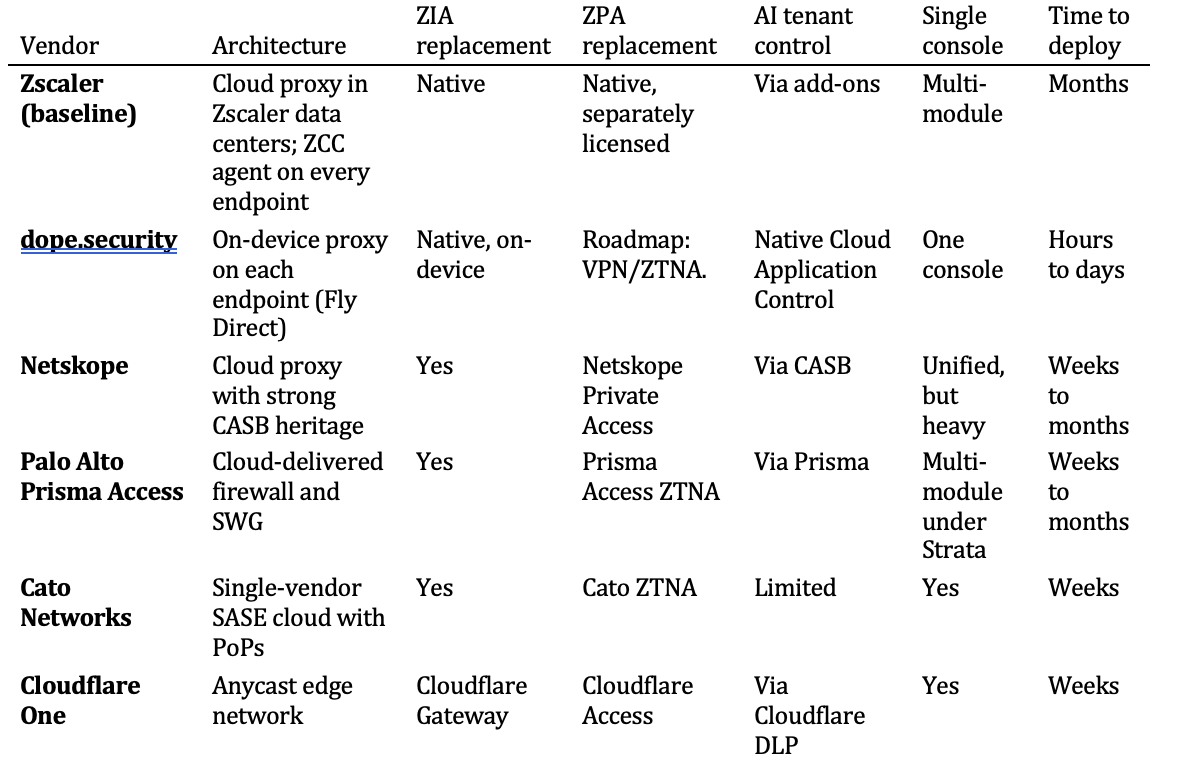
Two patterns to notice. First, every cloud-proxy alternative reproduces Zscaler's central architectural choice (route the traffic through us). That solves the SSL visibility problem the same way Zscaler does, with the same data-center dependency, the same backhaul question, and similar pricing exposure. Second, dope.security is the option in the table that breaks the pattern: the proxy lives on the endpoint, not in a vendor data center, so the inspection happens before the traffic ever leaves the laptop.
dope.security: the on-device Zscaler alternative
dope.SWG is an agent-based Secure Web Gateway. SSL inspection, URL filtering, anti-malware, Cloud Application Control, analytics, and Dopamine DLP all run on the device. Traffic flies direct to the destination. There is no stopover data center.
What this means for a team replacing Zscaler:
• HTTPS inspection without backhaul. The architectural argument that drives most Zscaler departures resolves on day one. No tunnels. No PoP-to-PoP latency. No "which Zscaler PoP did Singapore route through this morning."
• Cloud Application Control as a native feature. Allow your corporate Microsoft 365, Google Workspace, ChatGPT, and Claude tenants. Block the personal logins on the same hostnames. The layer ZIA cannot reach without add-ons. (Blocking Personal Claude Accounts.)
• Dopamine DLP for data in motion. AI-powered inspection of file uploads and AI prompts. PII, PCI, PHI, and IP detection without regex policy authoring. US Patent no. 12,464,023. (Meet Dopamine DLP.)
• One agent. One console. Mac native and Windows. Under 100 MB of RAM. Up to 4x performance versus legacy cloud-proxy SWGs.
• Real Zscaler displacement. A mid-market healthcare organization replaced Zscaler with dope.security and pulled backhaul out of clinical workflows. (Healthcare Zscaler displacement case study.)
For the side-by-side, the Zscaler vs. dope.security page breaks down where the cloud-proxy vs. agent-based architecture diverges in performance, privacy, and cost.
Netskope: the CASB-heavy cloud proxy
Netskope is the closest functional peer to Zscaler in 2026. Strong CASB heritage. Mature inline DLP for sanctioned SaaS. The proxy is cloud-hosted, traffic still routes through Netskope data centers, and Netskope Private Access covers the ZTNA piece that Zscaler splits into ZPA.
Where it wins: the strongest CASB feature set in the cloud-proxy peer group, especially for teams whose data lives mostly in Microsoft 365 and Google Workspace.
Where it bites: same backhaul model as Zscaler, similar pricing posture, and the deployment lift is closer to a Zscaler migration than to an agent-based swap. If you're leaving Zscaler because the architecture feels too central, Netskope reproduces the central architecture with a different logo.
Palo Alto Prisma Access: the firewall lineage
Prisma Access is the Palo Alto cloud-delivered firewall and SWG. It's the SSE move for teams already invested in Palo Alto's NGFW and Strata stack. Like Zscaler, it's a cloud-proxy model: user traffic routes through Palo Alto's cloud for inspection, with consistency back to the on-prem NGFW policy.
Where it earns its slot: teams running Palo Alto on the perimeter who want one policy plane across on-prem and remote.
Where it bites: the heritage shows up in pricing, packaging, and partner-led services engagements. The 2026 SSE buyer who picks Prisma Access is usually picking Palo Alto first and SSE second. See Palo Alto Prisma Access Alternatives in 2026 for the parallel comparison.
Cato Networks: the single-vendor SASE bet
Cato runs its own global PoP network and a single-vendor SASE stack. SD-WAN, SWG, CASB, ZTNA, and FWaaS all live under one cloud. The console is unified out of the gate, which is a real differentiator against Zscaler's multi-product setup.
Where it wins: greenfield SASE deployments at multi-site organizations replacing MPLS at the same time. The bundle math is cleaner.
Where it bites: same fundamental cloud-PoP architecture as Zscaler. Replacing one cloud-PoP SSE with another doesn't change the architecture; it changes the vendor.
Cloudflare One: the anycast edge
Cloudflare One bundles Cloudflare Gateway (SWG), Cloudflare Access (ZTNA), Cloudflare DLP, and the broader Zero Trust stack on Cloudflare's anycast edge. The architecture is a third path: not on-device, not centralized cloud-proxy, but inspection at Cloudflare's edge nodes close to the user.
Where it wins: teams already on Cloudflare for DNS and CDN, comfortable with the edge model and willing to consolidate.
Where it bites: still an edge-not-endpoint model, so the same direct-to-internet question remains open. DLP and CASB maturity is improving but trails Zscaler and Netskope.
The shortlist by use case
• You want on-device SSL inspection, AI governance, and a fast deployment with no data-center dependency. dope.security.
• You're CASB-first, your data lives in M365 and Google Workspace, and you accept the cloud-proxy model. Netskope.
• You're already deep in Palo Alto Networks and you want SSE consistency with NGFW. Prisma Access.
• You're consolidating MPLS and SSE in one motion at a multi-site org. Cato.
• You're already heavily invested in Cloudflare's edge and you want to consolidate. Cloudflare One.
• You actually like Zscaler and your renewal isn't punitive. Stay on Zscaler. Switching is real work.
FAQ
What is the best Zscaler alternative in 2026?
The right Zscaler alternative depends on the reason you're leaving. If the architectural question (why does my traffic need to visit a third-party data center?) is the driver, dope.security is the agent-based option that resolves it. If you're staying with cloud-proxy and want the strongest CASB, Netskope. If you're consolidating with an existing Palo Alto stack, Prisma Access. If you're replacing MPLS at the same time, Cato.
Can I replace ZIA without replacing ZPA?
Yes, but read the contract carefully. The ZIA and ZPA bundle math at Zscaler often makes a partial replacement less attractive than people expect. Several teams replacing ZIA with dope.security keep an existing ZTNA point product for internal-app access during the transition, then reassess in the next renewal cycle. The Zscaler ZIA vs ZPA post breaks down what each piece actually covers.
Is Zscaler too expensive in 2026?
Pricing is the most common reason teams pick up the phone, but the architectural reasons usually keep them on the call. Cloud-proxy SSE vendors carry direct exposure to data-center costs, which are climbing as AI infrastructure consumes available rack capacity. See How Rising Data Center Costs Are Driving SASE & SSE Price Increases and the deep-dive on Zscaler Pricing in 2026.
What replaces the Zscaler Client Connector?
ZCC is the agent that establishes tunnels from each endpoint to Zscaler's cloud. An agent-based Zscaler alternative replaces ZCC with an on-device proxy that performs URL filtering and SSL inspection locally, with no tunnel. dope.security's agent does both, plus Cloud Application Control and Dopamine DLP, in a single install under 100 MB of RAM.
How long does it take to replace Zscaler?
Faster than most Zscaler partner statements of work suggest. dope.security customers regularly cut over inside 30 days. A mid-market healthcare organization swapped Zscaler for dope.security and pulled backhaul out of clinical workflows in the same renewal cycle (case study linked above). The detailed migration playbook is in How to Replace Zscaler in 30 Days.
Does dope.security have ZPA equivalent for internal apps?
A VPN/ZTNA capability is on the dope.security roadmap. Many teams replacing Zscaler keep their existing ZTNA point product or revisit whether they need a separate ZTNA at all once SWG runs direct-to-internet on the device.
Make the switch
The fastest way to evaluate a Zscaler alternative is to put it next to ZIA on real traffic. dope.security has an instant trial. Sign in with your corporate Google or Microsoft account, push the agent to a pilot group of 25 endpoints, and run side-by-side for a week.
Start the free dope.security trial or book a 20-minute working session and we'll map your ZIA and ZPA footprint to a clean replacement plan.
.jpeg)


