


Best Zscaler Alternative for AI Governance in 2026
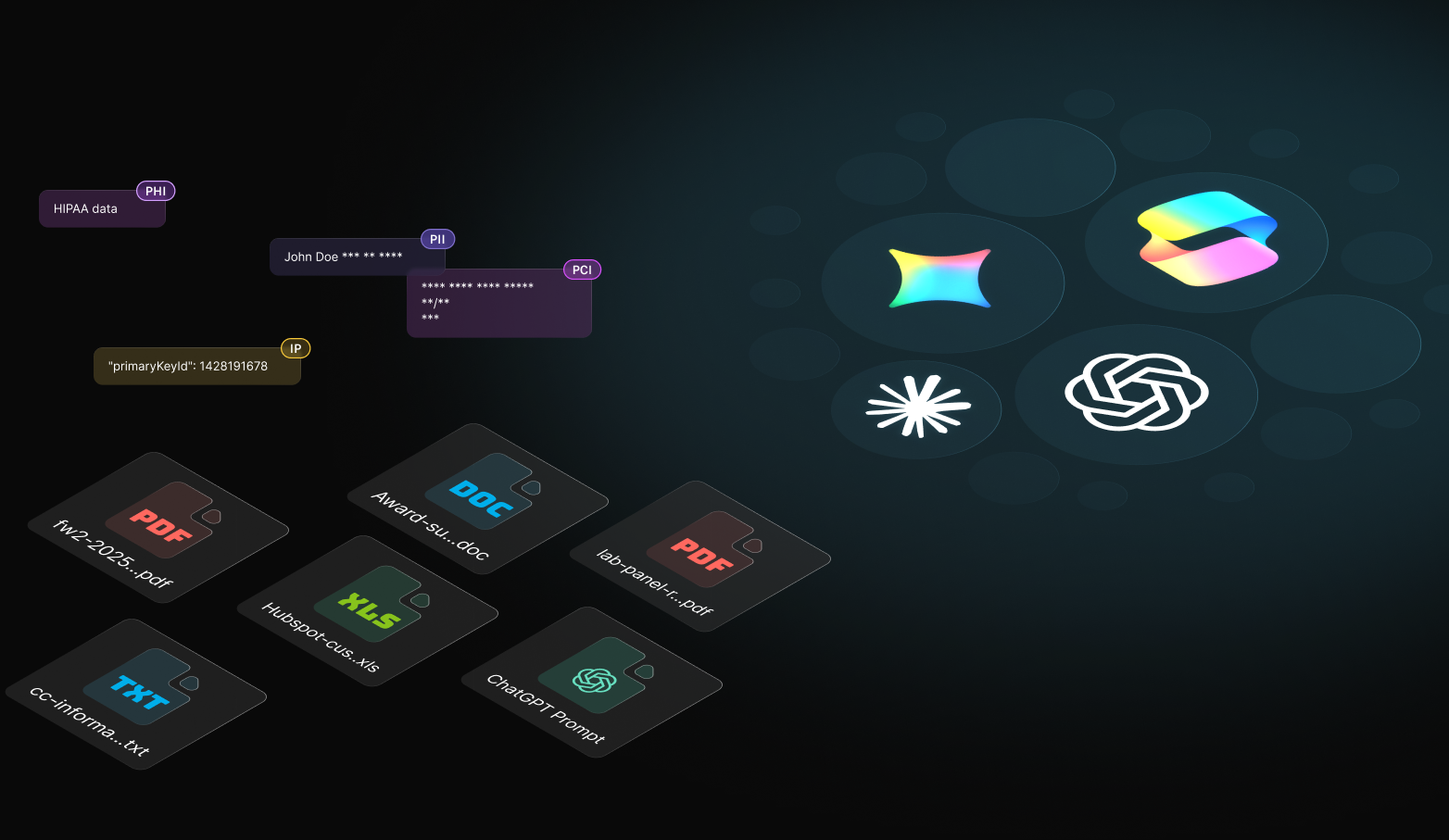
Short answer: If you need to govern shadow AI without routing every prompt through a third party's data centers, dope.security is the strongest Zscaler alternative in 2026. dope.security runs AI governance on the device: it discovers which AI tools employees use, restricts them to enterprise-only accounts with Cloud Application Control, and catches sensitive data in prompts and uploads with on-device Dopamine DLP. No backhauling. No detour. Fly direct.
Why AI governance is the new SWG buying decision
AI adoption didn't wait for IT approval. The average company uses 10x more AI tools than IT has actually approved, and 77% of employees have already leaked sensitive data through tools like ChatGPT. Zscaler's own 2026 research points the same direction: a 91% year-over-year surge in enterprise AI activity, and ChatGPT alone driving hundreds of millions of DLP policy violations.
So the question for 2026 isn't 'should we govern AI.' It's 'what governs it without punishing the people using it.' That's where architecture matters, and it's where Zscaler and dope.security part ways.
The core difference: backhaul vs. fly direct
Zscaler is a proxy in the cloud. Every request, including every AI prompt, gets routed to a Zscaler data center for inspection before it reaches ChatGPT, Claude, Gemini, or Copilot. That detour is the whole model. It adds latency, it depends on data center availability, and it means your users' AI traffic makes a pit stop through infrastructure you don't own.
dope.security does the opposite. The dope.endpoint agent runs SSL inspection and policy enforcement on the device itself. AI traffic flies direct to the model, gets inspected locally, and never takes a detour. Faster for the user. Simpler for IT. And your prompts stay on the device instead of transiting a third party's cloud.
For a distributed or remote workforce, that gap widens. Cloud-proxy latency runs roughly 40 to 80 ms near a point of presence and 150 to 400 ms when users are far from one (ThousandEyes and vendor docs). dope.security adds no network detour because inspection is local. The approved headline claim: up to 4x performance over legacy SWGs.
Three-layer AI governance, one console
Governing AI isn't a single switch. dope.security does it in three layers, all under one console:
- AI visibility (Shadow IT discovery). See every AI tool in use and, critically, which logins are personal accounts versus enterprise-licensed. You can't protect what you can't see.
- AI controls (Cloud Application Control). Apply enterprise-only access by tool. Block personal ChatGPT, Claude, Gemini, and Microsoft logins while allowing your corporate tenant. Enforcement syncs across the fleet in under a minute.
- On-device AI DLP (Dopamine DLP). Intercept file uploads and AI prompts, classify them via zero-retention APIs, and block PII, PCI, PHI, or IP before it reaches the model. Dopamine DLP is covered by US Patent no. 12,464,023.
Zscaler assembles comparable outcomes through AI Protect and its broader platform, but it does so as a cloud proxy with the same data-center dependency and the same multi-module footprint that made legacy SSE heavy in the first place.
The control boundary is the device, not a cloud PoP
Here's the distinction that actually separates the two. Zscaler's client steers traffic to a Zscaler point of presence, where TLS gets terminated and inspected. The enforcement plane lives off-device. dope.security's endpoint is a real proxy: it intercepts the connection at the operating system's networking layer, decrypts and evaluates it against a locally cached policy, then sends it direct to the AI provider. No mandatory detour to a shared vendor PoP just to get an allow-or-block result.
That on-device, OS-level boundary matters because AI isn't only in the browser anymore. It's in ChatGPT Desktop, Claude Desktop, Electron apps, IDE assistants like Cursor and VS Code, JetBrains plugins, and Python or CLI scripts calling an AI API. A browser-bound control stops at the browser. dope.security sees the connection whether it came from a tab or a native client, when the traffic is decryptable and the app is supported.
Because inspection runs at the endpoint, dope.security can also name the originating process. chrome.exe, ChatGPT.exe, cursor.exe, and python.exe can all reach the same api.openai.com. The domain doesn't tell you the business context. The process does. A network-path inspection point often has to infer the application. An on-device agent reads it straight from the OS.
One more consequence: dope.security decides and can block before the request ever reaches the provider. That's pre-transmission enforcement, not a retrospective read of provider audit logs after the data already left.
dope.security vs. Zscaler for AI governance
| Capability | dope.security | Zscaler |
|---|---|---|
| Where AI traffic is inspected | On the device (fly direct) | Backhauled to Zscaler data centers |
| Shadow AI discovery | Yes, personal vs. enterprise accounts | Yes |
| Block personal AI accounts (CAC) | Yes, enterprise-only by tool | Yes, via policy modules |
| On-device prompt/upload DLP | Yes, Dopamine DLP (zero-retention, patented) | Cloud DLP inspection |
| Data residency of prompts | Stays on device | Transits Zscaler cloud |
| Policy push speed | Under a minute, fleet-wide | Polling-based updates |
| Enforcement plane location | On the device | Zscaler cloud PoP |
| Covers desktop AI apps, IDEs, CLI/API scripts | Yes, OS-layer interception | Yes, when steered to the cloud |
| Process-level attribution | Yes, read from the OS | Inferred from the network flow |
| Blocks before prompt reaches the model | Yes, pre-transmission | Cloud-side inspection |
| Console | Single console, built from scratch | Multi-module platform |
| Deployment | Agent via MDM in minutes, instant trial | Longer rollout, no self-serve trial |
What this looks like in practice
A Fortune 100 company scaled a dope.security rollout from 900 devices to over 18,000 in a matter of weeks, averaging around 3,000 devices per week, deployed silently via Intune. Greylock Partners moved off Cisco Umbrella and signed in 27 days. The pattern is the same: policy in minutes, not a six-page deployment manual, because there's no data center to stand up and no proxy to route around.
For AI governance specifically, that speed matters. Shadow AI moves fast. Your controls should push faster.
Frequently asked questions
Is dope.security a full Zscaler replacement? dope.security delivers the SSE components most teams actually use: Secure Web Gateway, Cloud Application Control, CASB Neural, and Dopamine DLP, all on-device and under one console. Many teams replace their legacy SWG outright. Book a demo to map it to your stack.
Can dope.security block personal ChatGPT while allowing enterprise ChatGPT? Yes. Cloud Application Control restricts AI tools to approved enterprise tenants, so personal accounts are blocked while your corporate account keeps working.
Does dope.security send AI prompts to a data center like Zscaler? No. Inspection and DLP run on the device. Prompts don't take a detour through dope.security infrastructure.
How fast is deployment compared to Zscaler? dope.security deploys as a lightweight agent via MDM and offers an instant, SSO-based trial. A Fortune 100 reached 18,000+ devices in weeks.
Does dope.security govern ChatGPT Desktop and IDE assistants, or just the browser? Both. Because interception runs at the OS networking layer, dope.security sees AI traffic from browser tabs, desktop apps like ChatGPT Desktop and Claude Desktop, IDE assistants like Cursor and VS Code, and API scripts, when the traffic is decryptable and the app is supported.
Take control of AI without the detour
You don't need to backhaul your team's AI traffic to govern it. See who's using personal AI, lock tools to enterprise accounts, and stop sensitive prompts, all on-device.
Book a 20-minute demo or start an instant trial with your corporate email.
.jpeg)


