


Best Palo Alto and Forcepoint Alternative for AI Data Protection in 2026
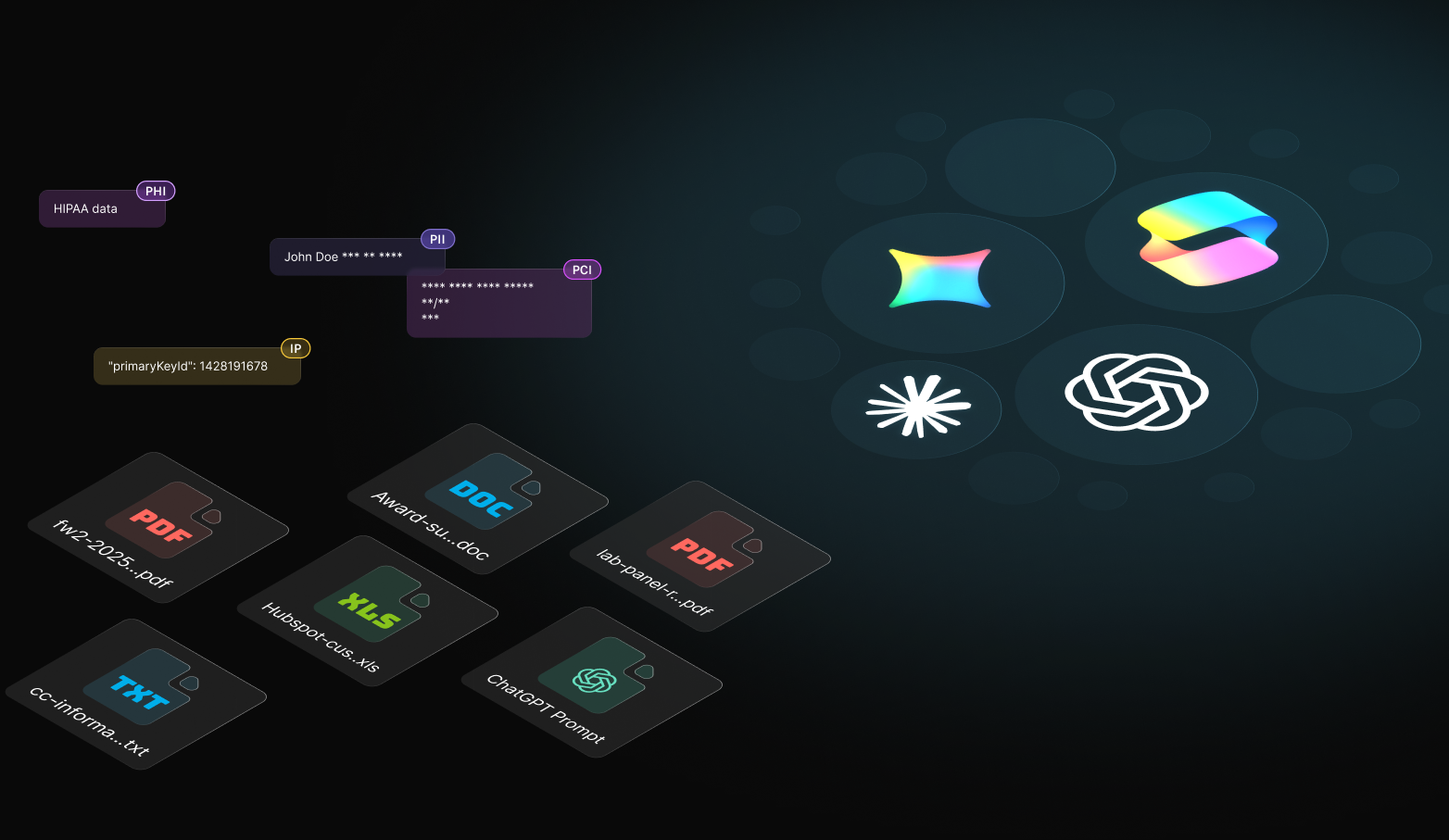
Short answer: Legacy enterprise DLP from Palo Alto and Forcepoint was built to guard email, endpoints, and network channels, not the AI prompt box. dope.security protects data where AI risk actually happens: on the device, in the prompt and the upload, before anything reaches ChatGPT, Claude, or Gemini. That focus, plus a single console and fly-direct architecture, makes it the strongest Palo Alto and Forcepoint alternative for AI data protection in 2026.
The AI prompt is the new data exfiltration channel
Traditional DLP maps to traditional channels: email attachments, USB, network egress, cloud storage. Those still matter. But the fastest-growing leak path in 2026 is a text box. Employees paste customer records, source code, and IP into AI tools every day. 77% of employees have already leaked sensitive data through tools like ChatGPT, and the average company runs 10x more AI tools than IT approved.
Palo Alto (Prisma Access, Enterprise DLP) and Forcepoint DLP are mature at the classic channels. The gap is the AI-native one: inspecting the actual prompt and the actual upload at the moment of use, without routing it all through a cloud service first.
Where the data protection happens
Palo Alto and Forcepoint largely inspect in the network path or the cloud. Prisma Access is a cloud-delivered service; Forcepoint's controls span endpoint and cloud but lean on policy-heavy, enterprise-grade configuration. Both bring real capability and real weight: multiple modules, longer deployments, and for the cloud-proxy paths, the same backhaul detour that adds latency.
dope.security keeps it on the device. Dopamine DLP intercepts file uploads and AI prompts locally, classifies the content via zero-retention APIs (no training on your data), and blocks PII, PCI, PHI, or IP before it leaves the endpoint. Three modes: Block, Monitor, Off. It's covered by US Patent no. 12,464,023. Because inspection is local, there's no prompt detour through a vendor cloud, which is better for latency, for privacy, and for data residency.
Context beats pattern matching for AI DLP
A useful AI DLP decision is rarely just 'does this string contain a card number.' It's 'is a finance user, in a personal ChatGPT workspace, from ChatGPT Desktop, uploading a board forecast with non-public numbers.' Traditional enterprise DLP is excellent at file operations and OS actions, but its coverage of third-party AI request semantics, the actual prompt body and the structure of a native client's API calls, varies.
dope.security runs at the endpoint's application and network boundary, so it combines several signals in one decision: identity (user, group, device), application (originating process, browser vs. desktop client), network (domain, full URL, destination), content (prompt text, extracted file text, DLP category), and account (approved vs. personal tenant). Dopamine DLP extracts the text and classifies it rather than leaning on regular expressions alone, which is designed to reduce both false positives (a harmless example number) and false negatives (sensitive business meaning with no standard pattern). Measure precision and recall against your own documents in a proof of concept, because 'uses an LLM' isn't proof of accuracy on its own.
And it decides before the request leaves the device. That's pre-transmission enforcement: the prompt or upload is blocked before the AI provider ever receives it, not caught in a report after the fact.
AI data protection is only one layer
Stopping the leak is necessary, but governance needs context. dope.security pairs Dopamine DLP with two more layers under one console:
- AI visibility (Shadow IT discovery): see every AI tool and which logins are personal vs. enterprise.
- Cloud Application Control (CAC): restrict AI tools to approved enterprise tenants, blocking personal accounts while keeping corporate ones live, synced fleet-wide in under a minute.
And for data at rest, CASB Neural scans OneDrive and Google Drive for externally shared files containing PII, PCI, PHI, or IP, with one-click remediation, plus AI-powered SSPM to govern the third-party OAuth apps connected to your tenant. That's data in motion and data at rest, in the same console.
dope.security vs. Palo Alto and Forcepoint for AI data protection
| Capability | dope.security | Palo Alto | Forcepoint |
|---|---|---|---|
| On-device prompt/upload DLP | Yes, Dopamine DLP (patented) | Cloud/network-path DLP | Endpoint + cloud DLP |
| Zero-retention AI classification | Yes | Varies | Varies |
| Combines identity + app + content + account context | Yes, at the endpoint boundary | Channel/policy-centric | Channel/policy-centric |
| Classification approach | Extracts text and classifies (not regex-only) | Rules and patterns | Rules and patterns |
| Blocks before prompt reaches the model | Yes, pre-transmission | Varies by channel | Varies by channel |
| Process-level attribution | Yes, read from the OS | Network/agent dependent | Agent dependent |
| Blocks personal AI accounts (CAC) | Yes, enterprise-only | Via policy modules | Via policy modules |
| Shadow AI discovery | Yes | Yes | Yes |
| Data at rest (CASB) + SSPM | Yes, CASB Neural | Separate products | Separate products |
| Architecture | Fly direct, on-device | Cloud-delivered (backhaul) | Policy-heavy, multi-module |
| Console | Single console | Multi-module platform | Multi-module platform |
| Deployment | Agent via MDM, instant trial | Longer rollout | Longer rollout |
Why the on-device model wins for AI
Two reasons. First, timing: the only reliable place to stop a prompt leak is before the prompt leaves the device. Inspect it locally and you catch it at the source. Second, privacy: routing every prompt through a vendor's cloud to inspect it creates the exact exposure you're trying to prevent. dope.security inspects on-device and uses zero-retention classification, so sensitive content isn't retained or used for training.
Frequently asked questions
Can dope.security stop employees pasting sensitive data into ChatGPT or Claude? Yes. Dopamine DLP inspects the prompt and the upload on the device and blocks PII, PCI, PHI, and IP in real time, with Block, Monitor, and Off modes.
Is this a full replacement for Palo Alto or Forcepoint DLP? It replaces the AI-native and web data-protection functions most teams need now, and adds Cloud Application Control, CASB Neural, and SSPM under one console. Book a demo to map it to your requirements.
Does dope.security send prompts to the cloud to inspect them? No. Classification runs on-device with zero-retention APIs. Prompts don't take a detour.
What about data sitting in OneDrive or Google Drive? CASB Neural scans for externally shared files containing sensitive data and offers one-click remediation, covering data at rest alongside data in motion.
Can dope.security tell a personal AI workspace from an enterprise one? Yes. Cloud Application Control enforces approved tenants, and the endpoint boundary lets DLP combine that account context with the originating process, the user, and the content of the prompt or upload in a single decision.
Protect data where AI risk actually happens
Stop sensitive prompts and uploads on the device, govern personal AI accounts, and cover data at rest, all in one console.
Book a 20-minute demo or start an instant trial with your corporate email.
.jpeg)


