


AI Visibility and Governance: The Complete Enterprise Guide for 2026
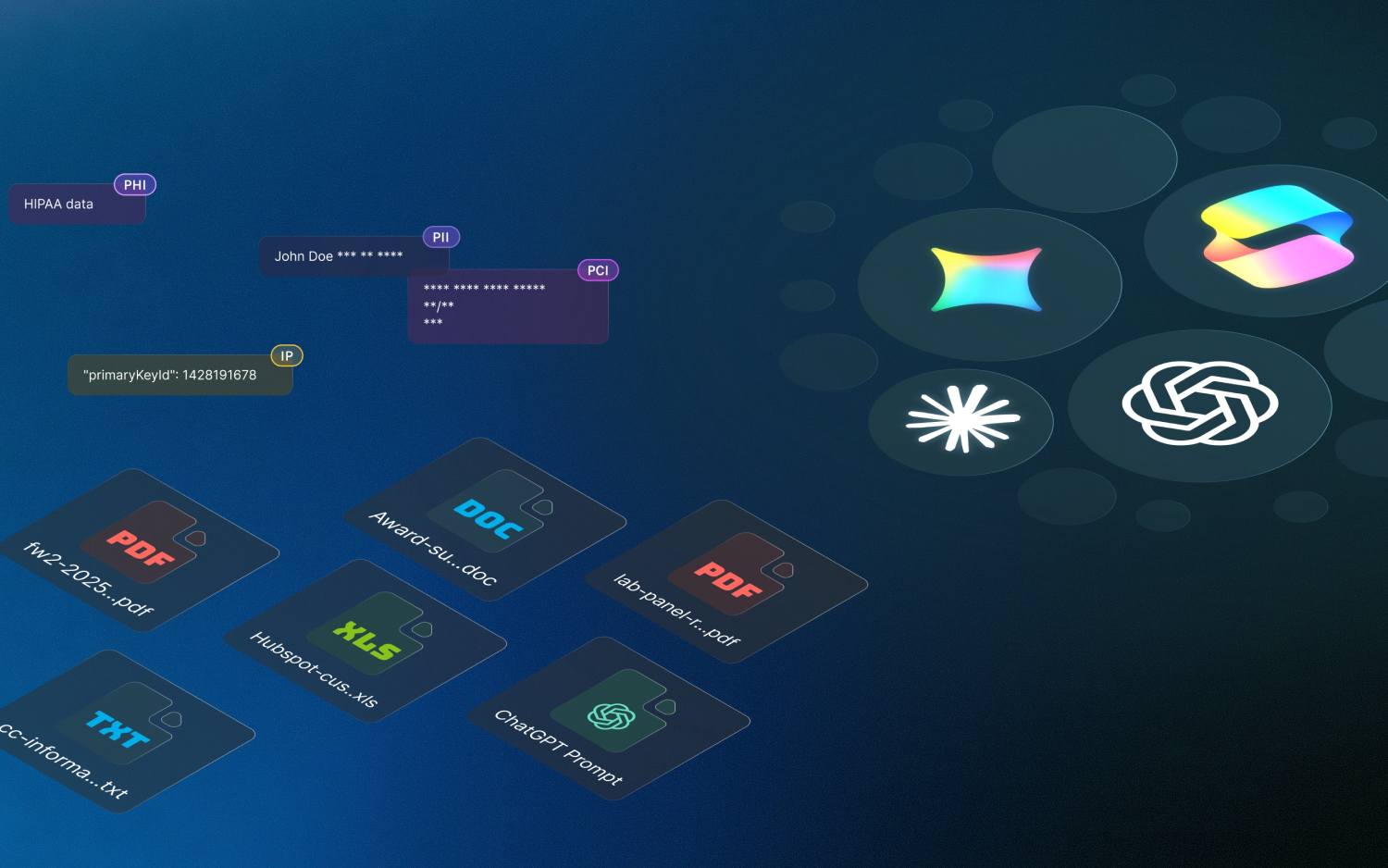
The short answer: AI governance is the practice of seeing every AI tool your people use, deciding what each one is allowed to do, and stopping sensitive data from leaving in a prompt or an upload. It is not a firewall rule and it is not a browser plugin. The hard part is telling a corporate AI account apart from a personal one on the same domain, and that only works when you inspect and shape traffic inside decrypted TLS on the device. dope.security does it with three layers: shadow AI discovery, secure web gateway policy, and Cloud Application Control for tenant level enforcement, backed by Dopamine DLP for prompts and uploads.
Every company has an AI problem now, and most of them cannot see it. Your people are pasting customer data into ChatGPT, summarizing board decks in Claude, generating code in Copilot, and running research through Gemini. Some of that is sanctioned. Most of it is not. The uncomfortable truth is that the average security team cannot answer three basic questions: which AI tools are in use, who is using a corporate account versus a personal one, and what data is going into the prompt. This guide answers how to govern all of it without becoming the team that blocks everything and gets ignored.
This is the hub for our AI governance coverage. The deep dives on shadow AI detection and governance, AI guardrails for ChatGPT, Claude, and Gemini, and enterprise AI security and shadow AI risk all link back here. Start with this page for the full picture, then go deep where you need to.
What does AI governance actually mean in 2026?
AI governance is the set of controls that give you visibility into AI usage, enforcement over what AI tools can do, and protection for the data that flows into them. Strip away the jargon and it comes down to three jobs: discover, control, and protect. Discover means knowing every AI app and account in play, including the personal ChatGPT login someone uses on a managed laptop. Control means deciding, per app and per account, what is allowed: full access, read only, warn, or block. Protect means inspecting what actually leaves, because the risk is not that someone opened ChatGPT, it is that they pasted a patient record or a pricing model into it.
Plenty of products claim AI governance. Far fewer do all three. A discovery dashboard that shows you a list of AI domains is visibility without action. A policy that blocks an entire domain kills productivity and gets a waiver by Friday. Real governance is granular, enforced at the point of use, and aware of the difference between your sanctioned enterprise tenant and the open consumer version of the same tool.
Why is shadow AI invisible to most security stacks?
Shadow AI is the use of AI tools outside the visibility and control of IT. It is the natural successor to shadow IT, and it is worse, because the barrier to entry is a free web login and the payload is your data, not just an unsanctioned app. The reason it stays invisible is architectural. Most legacy controls were built to make allow or block decisions at the network layer, and AI traffic does not cooperate.
Roughly 95 percent of web traffic is now encrypted. A DNS filter can see that a device asked for the address of chatgpt.com, but it cannot see the URL path, the account, or the prompt, because all of that lives inside the TLS session. A firewall can allow or deny the connection by IP, but the same IP serves the corporate tenant and the personal account. A browser extension can watch one browser on one operating system, but it misses the desktop app, the IDE plugin, and the API call. The result is a giant blind spot exactly where the data movement happens.
The single demo that exposes the gap is this: allow the corporate ChatGPT account, block the personal one, on the same domain. To do that you have to read and inject an HTTP header inside the decrypted TLS stream. DNS cannot. A browser plugin cannot do it everywhere. Most proxies need a separate data protection add-on and a higher license tier to get close. It is the cleanest test of whether a product does AI governance or just talks about it.
The three layers of real AI governance
Governance works when discovery, policy, and tenant control reinforce each other. dope.security runs all three on the device through a single lightweight agent and one console, so a tool you discover on Monday can be under policy on Monday. Here is how the layers map to the jobs.
| Layer | What it answers | How dope.security delivers it |
|---|---|---|
| 1. Shadow AI discovery | Which AI tools and accounts are in use, corporate vs personal | On device inspection sees every AI destination across browsers, desktop apps, and tools, not just one browser |
| 2. SWG policy | What each tool is allowed to do: allow, warn, or block | Fly Direct secure web gateway enforces URL and category policy on device, no backhaul, instant policy push |
| 3. Cloud Application Control | Allow the corporate tenant, block personal logins on the same app | Tenant level control by inspecting and injecting headers inside decrypted TLS, on the endpoint |
| Data protection | What sensitive data is going into a prompt or upload | Dopamine DLP inspects prompts and uploads with zero retention classification (US Patent 12,464,023) |
The takeaway: discovery without enforcement is a report. dope.security closes the loop from seeing a tool to controlling it to inspecting the data in one console.
Layer one: discovery you can act on
You cannot govern what you cannot see, so discovery comes first. The catch is that most discovery is partial. A network dashboard that only resolves domains tells you ChatGPT is popular but not whether the usage is corporate or personal, and not what surface it runs on. Because dope.security inspects on the device, discovery covers the browser, the desktop client, and other egress, and it distinguishes the sanctioned tenant from the open account. That distinction is the whole game, because it is the difference between healthy adoption and uncontrolled data exposure. Our walkthrough of shadow AI detection and governance shows what that discovery looks like in practice.
Layer two: policy that is granular, not binary
Once you can see the tools, you decide what each is allowed to do. Binary allow or block is where most programs fail, because a blanket block on AI is unenforceable and a blanket allow is negligent. Granular policy lets you allow Gemini for marketing, warn on a coding assistant for the finance team, and block a sketchy new image generator entirely. Because the Fly Direct secure web gateway enforces on device, policy follows the user onto home networks and coffee shop Wi Fi, and changes push in seconds rather than the polling cycles legacy proxies rely on.
Layer three: tenant control, the part that is hard to fake
This is the layer that separates governance from theater. Cloud Application Control lets you allow your company ChatGPT, Claude, or Microsoft 365 tenant while blocking personal logins to the same services. It works because dope.security inspects traffic inside decrypted TLS on the endpoint and can act on the header that identifies the account. The deep dive on AI guardrails for ChatGPT, Claude, and Gemini covers how this plays out tool by tool.
How AI governance vendors actually compare
Most SSE and security vendors have bolted AI features onto an architecture that was not designed for them. The matrix below uses documented capability, not marketing claims. Strong means it ships and is credible, Partial means it is gated, narrow, or add on dependent, and Gap means it is absent or unproven. The pattern is consistent: discovery is common, but native tenant control and semantic prompt inspection are rare, and they usually cost extra.
| Vendor | Discovery | Tenant control | Semantic prompt DLP | All AI surfaces | Native, no add-on |
|---|---|---|---|---|---|
| dope.security | Strong | Strong | Strong | Strong | Strong |
| Zscaler | Strong | Partial | Partial (add-on) | Partial | Gap (add-on) |
| Netskope | Strong | Strong | Strong (top tier) | Partial | Gap (SKU) |
| Cisco Umbrella | Partial | Gap (DNS) | Gap | Gap | Gap |
| Cloudflare | Strong | Partial (header) | Partial (beta) | Gap | Gap (Contract) |
| Menlo | Partial | Gap | Gap (dictionary) | Gap (browser only) | Partial |
Documented capability as of mid 2026. Several vendors ship strong AI features, but as higher tier SKUs on a bolt on architecture. dope.security delivers all five natively.
Two honest notes. Netskope genuinely has a rich AI feature set, with real time prompt and response inspection, but it sits in a higher Max Advantage tier and runs on a bolt on architecture, so the critique is the extra SKU, not the capability. Zscaler can do prompt level DLP, but only once you license the Data Protection add-on plus AI Guard on top of the base proxy. The point of governance is to control AI without assembling a tower of licenses to do it.
Why legacy SSE struggles with AI
The reasons AI governance is hard on legacy platforms are the same reasons those platforms struggle in general. First, backhauling. Routing every request to a distant point of presence and back adds latency on every call, and AI workflows are chatty. Second, the cloud control plane is a single point of failure, and when it has a bad day you can lose dashboards and logs in the middle of an incident. Third, SSL inspection breaks real apps, so teams build bypass lists that become the exact blind spots where AI traffic hides. Fourth, growth by acquisition left many vendors with multiple consoles and inconsistent policy models, so AI controls live in a different pane than the proxy. Fifth, and most telling, AI governance is usually a bolt on rather than a foundation, which is why it shows up as an add-on SKU.
dope.security took the opposite path. The agent runs on the device, traffic flies direct to its destination, SSL inspection happens locally so data stays on the endpoint, and one console built from scratch covers SWG, CASB Neural, and DLP. The agent uses under 100 MB of RAM and delivers roughly 4x the performance of legacy proxy SWGs. It even works in China without a paid uplift, which is where several legacy vendors sell a premium tier to paper over a structural weakness.
DLP for AI: govern the prompt, not just the app
Controlling which AI tool someone uses is necessary but not sufficient. The data risk is in the prompt and the upload. Someone with full access to your sanctioned ChatGPT tenant can still paste a customer list into it. That is why data protection is the fourth pillar of any serious AI governance program.
Dopamine DLP inspects file uploads and AI prompts at the moment they leave the device and classifies them using a zero retention API, which means the content is evaluated and nothing is stored or used for training. It runs in three modes, Block, Monitor, and Off, so you can start in Monitor to learn your real exposure, then move to Block where it matters. Because it runs on the endpoint, it covers data in motion across AI tools, not just one sanctioned app. For data already sitting in your SaaS tenants, CASB Neural scans OneDrive and Google Drive for externally shared files that contain sensitive data and remediates with a click. Our guide to the best DLP for AI goes deeper on how prompt inspection should work.
How to choose an AI governance approach
Use this decision table to match an approach to what you actually need. The common mistake is buying a discovery tool and calling it governance, or assuming a DNS filter or a browser extension can do tenant control. They cannot.
| Approach | Sees the prompt? | Corporate vs personal? | Covers all surfaces? | Best for |
|---|---|---|---|---|
| DNS filtering | No | No | No | Coarse domain blocking only |
| Browser extension | Sometimes | Partial | No (one browser) | Light single browser visibility |
| Proxy plus add-on | With paid add-on | Partial | Partial | Teams already locked into a legacy stack |
| dope.security (on device) | Yes | Yes | Yes | Teams that want one console for discovery, control, and DLP |
If you need to tell a corporate account from a personal one and inspect the prompt, you need on device TLS inspection. Everything above it is a partial measure.
Building an AI governance program people will actually follow
The best technology fails if the program around it is hostile. Start in Monitor mode and measure real usage for two to four weeks. You will almost always find more AI tools than you expected, and the data turns an abstract policy debate into a concrete one. Next, sanction the winners. Pick the corporate tenants you will support, turn on Cloud Application Control so those are allowed and personal logins are blocked, and communicate the why. Then layer DLP on the prompt, starting with your most sensitive data types. Finally, review monthly, because the AI landscape moves and a new tool will be popular before your next quarterly meeting.
One of the fastest ways to lose the room is latency and friction. If your controls make AI slow or unreliable, people route around them. Because dope.security runs on the device and flies direct, governance does not come with a performance tax, which is what keeps adoption healthy. A Fortune 100 company deployed the agent to more than 18,000 devices in record time, and Outreach Health secured 99 percent of its devices within a week while cutting web access tickets by 70 percent in 90 days. Governance that deploys fast and runs light is governance that sticks.
Frequently asked questions
Is AI governance the same as blocking ChatGPT?
No. Blocking is the blunt version that fails. Real governance lets you allow the sanctioned corporate account, block the personal one, and inspect what data goes into the prompt, so people stay productive and your data stays protected.
Can a DNS filter or firewall govern AI?
Not meaningfully. DNS sees the domain but not the account or the prompt, and a firewall allows or denies by IP while the corporate and personal versions share the same address. You need TLS inspection on the device to act on the account and the content.
What is shadow AI?
Shadow AI is the use of AI tools outside the visibility and control of IT, usually through free personal logins on managed devices. It is the main reason sensitive data leaks into AI, and discovery is the first step to controlling it.
Does inspecting prompts mean my data is stored?
Not with dope.security. Dopamine DLP classifies prompts and uploads using a zero retention API, so content is evaluated in the moment and nothing is stored or used for training.
The bottom line
AI is now part of how your company works, so the goal is not to stop it, it is to see it, shape it, and protect the data inside it. The capability that defines real governance is the one most tools cannot deliver: telling a corporate AI account apart from a personal one on the same domain, and inspecting the prompt, which requires decrypting and acting on traffic at the device rather than guessing at the network edge or watching a single browser. That is the foundation dope.security was built on, with shadow AI discovery, secure web gateway policy, Cloud Application Control, and Dopamine DLP under one console. If you want zero risk productivity instead of a pile of blocked domains and a waiver queue, book a 20 minute demo and see your real AI usage on day one.
.jpeg)
.jpeg)
.jpeg)


